Query-time attention
The local retrieval model attends over the original memory text and the query, so token-level details, relationships, names, dates, and code identifiers stay available.

Attemory indexes long memory, documents, and codebases into reusable KV state, then retrieves evidence through model attention instead of vector similarity.
These SOTA-class results are not marketing slogans: they are locally reproducible, with no benchmark-specific hacks. See details.
Different Retrieval Primitive
Instead of compressing each chunk into a fixed vector before the query is known, Attemory lets the query interact with model-readable memory at retrieval time.
The local retrieval model attends over the original memory text and the query, so token-level details, relationships, names, dates, and code identifiers stay available.
Raw corpora are prefilled once into reusable KV cache. Later searches restore cached attention state locally, so repeated retrieval avoids replaying the corpus from scratch.
Search does not generate tool calls, reasoning traces, or answers token by token. The query runs as a prefill over restored memory state, and the ranking comes back directly.
Request-time query context can define what kind of evidence matters, such as definitions, call sites, temporal facts, or table relationships, without changing the indexed corpus.
Interactive Explorer
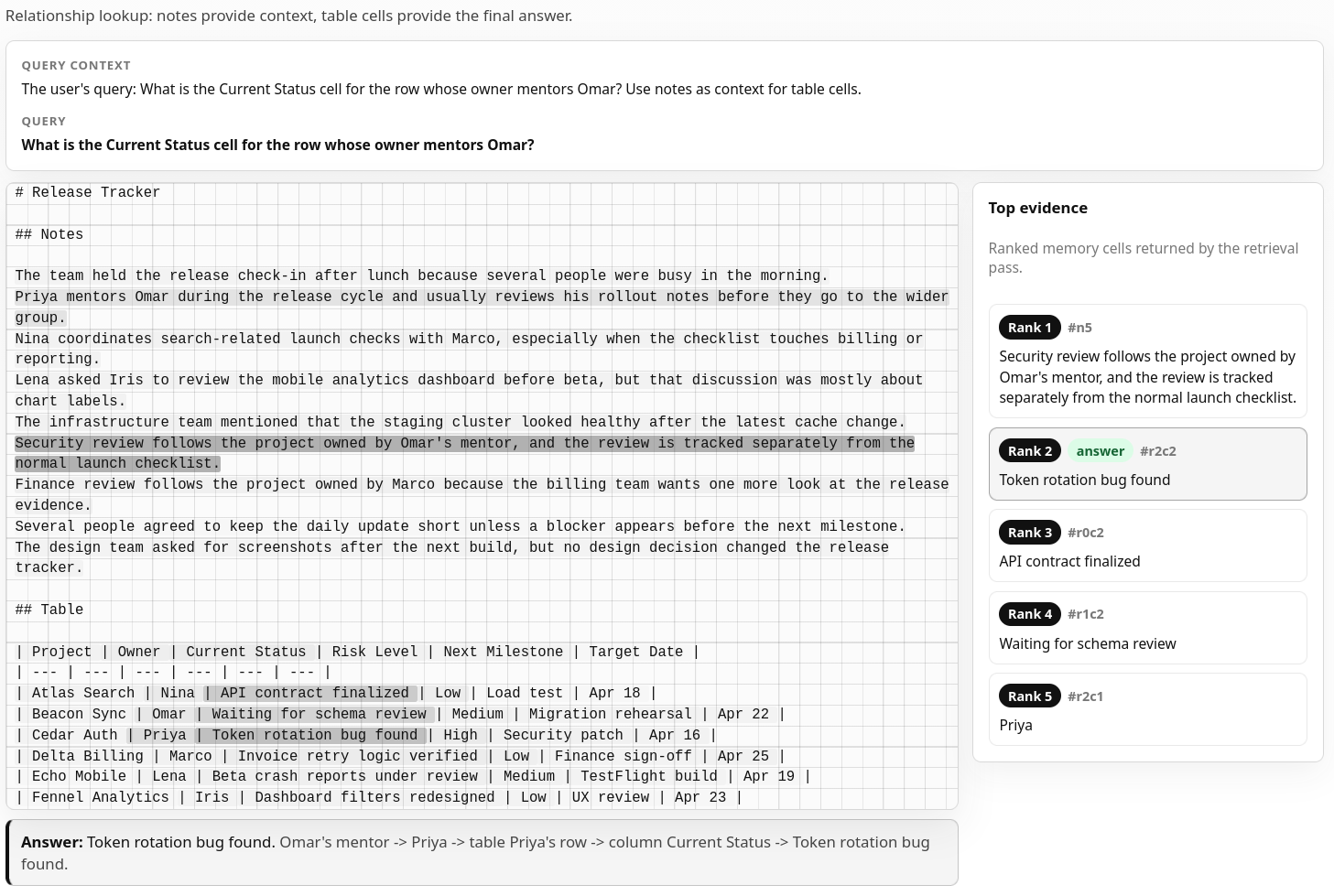
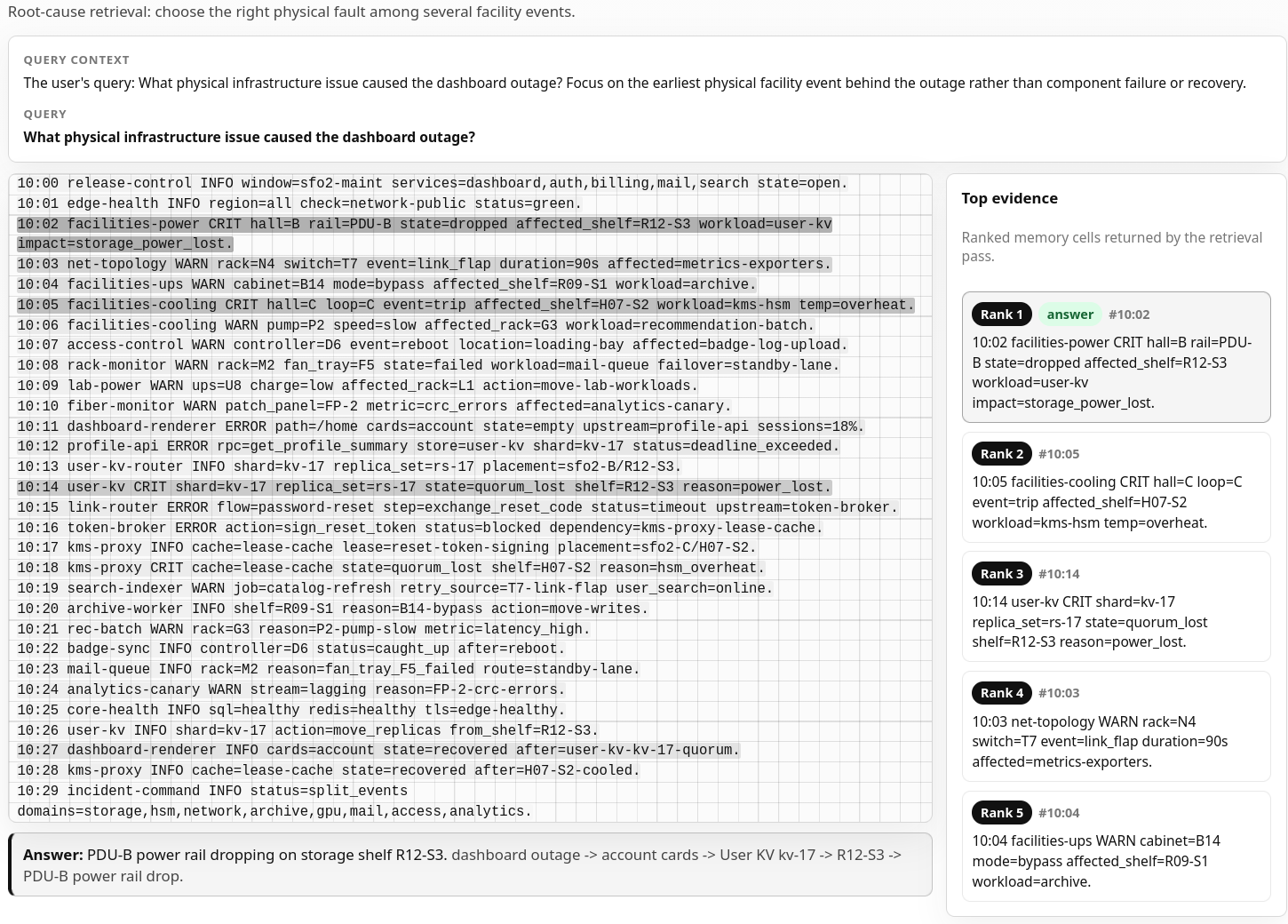
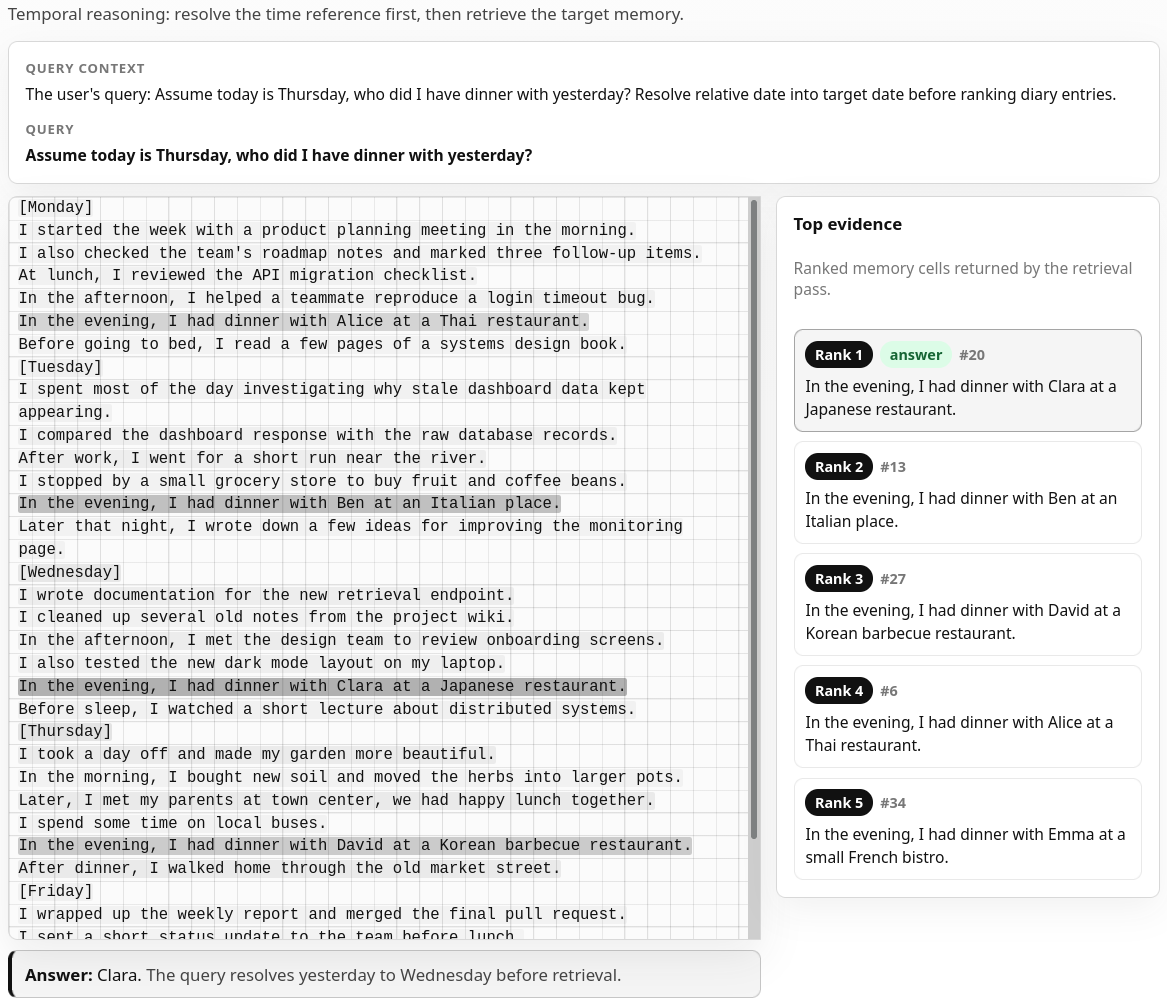
The explorer visualizes real Attemory search runs over a diary, a table, and an incident timeline. It shows how query context can shift retrieval, how a table cell can be found from row and column context, and how an incident query can trace a symptom back to a root cause.
Interactive ExamplesAgent Token Savings
On SWE-QA1, Attemory changes only the initial context: the same downstream Claude Code setup receives one semantic-search hint before it starts repository exploration.
| System | Judge score | Total tokens | Main-agent tokens | Subagent tokens | Turns | Tool calls | Cost estimate2 |
|---|---|---|---|---|---|---|---|
| Baseline | 83.39 | 285.39M | 122.60M | 162.80M | 10,491 | 26,997 | $453.47 |
| Attemory hint | 83.17 | 160.39M | 86.60M | 73.79M | 8,765 | 17,340 | $296.68 |
| Change | -0.23 | -43.8% | -29.4% | -54.7% | -16.5% | -35.8% | -34.6% |
1 SWE-QA is an end-to-end repository question-answering benchmark; this comparison covers 15 repositories and 720 paired questions.
2 Cost estimate is the total_cost_usd value emitted by Claude Code in the final stream-json result event.
SOTA Retrieval Quality
High recall is what makes token savings usable. Attemory reaches SOTA-class results across long conversations, million-token memory, and multi-language codebases. LongMemEval-M is notable: its context is long enough that few memory systems evaluate on it, while Attemory reaches SOTA Recall_all.
The results above come from reproducible local benchmark runs on raw corpora and raw benchmark queries, without query rewriting, summarization-as-storage, agent-driven exploration, BM25/vector hybrid stacks, or cloud retrieval services. See the benchmarks for details.
Use Attemory Your Way
Choose the runtime for your machine. The same targets work with pip; CUDA 12.6 is the default Linux CUDA wheel index.
# macOS Apple Silicon, includes Metal runtime
uv pip install attemory

# Linux CPU
uv pip install "attemory[cpu]"

# Linux CUDA
uv pip install "attemory[cuda]" \
  --extra-index-url https://attemorysystem.github.io/attemory/whl/cu126/
Install docs
Use Python or HTTP APIs for long memory, documents, benchmark adapters, and custom applications.
attemory-server --small --backend gpu --port 9006

python - <<'PY'
from attemory import AttemoryClient
client = AttemoryClient(port=9006)
client.add_memory("The deploy freeze starts at 18:00 UTC.")
print(client.search("When does the deploy freeze start?"))
PY
Docs for details
Index a codebase once, reuse the saved session across many questions, and return file/range evidence from the CLI or Claude Code plugin.
# CLI usage
atcode init
atcode index
atcode search "where is session restore implemented"

# Claude Code plugin
claude plugin marketplace add AttemorySystem/attemory-claude-code
claude plugin install attemory-code@attemory
claude -p "Use attemory-code search to find where session restore is implemented. Explain the control flow and key files in detail."
Docs for details